
By Shannon Pendleton
*Spoilers for seasons 1 and 2 of Severance*
After three long years, the award winning TV series Severance returned to our screens on the 17th January with its mind-bending season 2, picking up right where it left off.
The mystery sci-fi drama centres on Lumon Industries, a shadowy corporation that requires its employees to undergo a procedure that splits their consciousness in two. Their “innie” exists solely within the confines of the workplace, with no memory of their outside life, while their “outie” lives a personal life unaware of anything that happens at work.
In this season, we learn more about the inner workings of Lumon Industries and how the company’s insidious tactics of control have driven its workers to the edge. In doing so, the show sharpens its condemnation of the capitalist structures that govern Western societies today.
The reality of the severance procedure is that Lumon employees enslave parts of themselves, stripping them of autonomy and dignity, to do the things they don’t want to do or to rid themselves of the pain they don’t know how to endure.
The result is that the “innies” become child-like versions of themselves, devoid of history, starved of context and meaning as it’s drummed into them that their singular life mission is to serve Kier, the company’s founder. Time passes by fiscal quarters instead of seasons and, unable to reap the benefits of their pay cheques, their only motivations consist of vending machine snacks, finger traps, and waffle parties – hollow gestures to keep them grateful and in their place.
These childish perks mirror the ways corporations often infantilise their own workers with pizza parties and free snacks to keep them distracted from deeper issues like burnout, limited upward mobility, or wage stagnation.

Furthermore, Lumon manipulates its workers by creating an illusion of control. In the very first episode, when Helly R is freshly forced into existence as a data refiner, Mark S recites a line that was likely told to him on his first day: “Every time you find yourself here, it’s because you chose to come back”. The reality is that Helly and Mark didn’t choose to come back – their outies did. In the same episode, Helly’s outie – Helena Eagon, CEO of Lumon – records a video for Helly, asserting that she gives consent to spatially partition her memories. Mr Milchick, manager of the severed floor, presents Helly the video as if providing proof that she chose this life – but while Helena gave consent, Helly never did.
The ways in which severed employees are taught to believe they have control over their lives keeps them compliant and mirrors how real-world workers are similarly manipulated to ensure they remain willing prisoners to the same capitalist systems of exploitation. Indeed, while corporate workers are often presented with the illusion of choice – granted minor concessions such as casual dress codes or flexible working hours – the reality is that they have little to no control over their wages, working conditions, or job security. Even career progression is framed as a matter of personal choice and effort, neglecting to address the systemic barriers that keep genuine mobility out of reach for many.
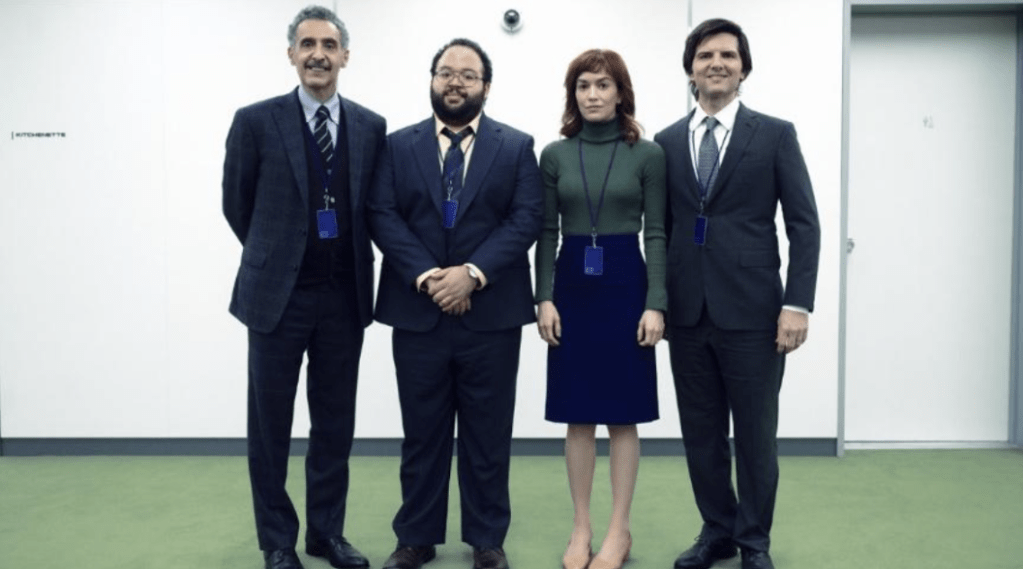
Dehumanising the innie: “I am a person, you are not”
Lumon’s ideology that innies are half-people and are therefore entitled to limited rights is prevalent throughout the show. Following Helly’s increasingly desperate resignation attempts, her outie records a video to set the record straight. Full of callousness, Helena is measured and calculating as she says, “I am a person, you are not. I make the decisions, you do not.” In another instance, Helena refers to the innies as “animals”. The ideology viewing innies as “half-people” aims to justify the abuse of the severed employees, while signalling that a hierarchy exists, and they are firmly positioned at the bottom.
Moreover, to sow division between departments, Lumon circulates propaganda posters depicting fictional inter-departmental uprisings where employees resort to cannibalistic combat methods. Bizarre rumours are also spread amongst the innies such as claims that members of other departments possess kangaroo-like pouches for bearing young. By portraying certain departments as animalistic and beast-like, the employees are deterred from mingling and learning more about the inner workings of Lumon. In turn, the departments are kept siloed and uninformed, redirecting suspicion and hostility laterally rather than upward, obscuring who truly holds power.
These kinds of fear tactics are all too common in the real world where the working class is conditioned to turn against one another before looking upward to see who’s truly pulling the strings. A striking example of this is the Brexit referendum in 2016 where the UK became deeply divided between those who wanted to leave the European Union (EU) and those who wished to remain. As a result of racist politicians such as Nigel Farage pedalling the narrative that immigrants were stealing British jobs while simultaneously draining the welfare system, the pro-leave camp became overrun by white working-class people who blamed the country’s economic decline on immigrants instead of holding the government to account. As these racist and xenophobic narratives gained widespread popularity, the working class fractured, directing their resentments sideways instead of upwards – and the result was a misinformed vote to leave the EU.
It’s also no coincidence that tabloid media often uses animalistic language to depict immigrants coming into the country. For example, in 2015, Katie Hopkins, a controversial columnist for The Sun at the time, referred to immigrants as “cockroaches” and “feral humans”.
The vile comparisons made between people of colour and animals dates to the era of transatlantic slavery where slavers – along with the societies that enabled them – used art, literature, and media to portray Black people as subhuman or primitive. Through such comparisons, colonisers justified their grotesque abuses, denying Black people basic human rights.
Similarly, Lumon utilises animalistic language and imagery to divide and conquer its workers.

While slavery’s horrors cannot be equated with corporate exploitation, Severance highlights how modern systems of labour control mirror the tactics of dehumanisation, division, and the justification of exploitation that were employed during slavery. By drawing these parallels, Severance becomes a damning indictment of both historical slavery and its echoes in modern day – critiquing the capitalist systems that commodify people, transforming them into ‘employees’ before they are allowed to be human.
Romance and love as an act of rebellion
Throughout the show, Mark S and Helly develop a romantic relationship and, in so doing, liberate themselves from the corporate shackles that govern their lives. This romantic dynamic intensifies when Helena deceives Mark into sleeping with her by impersonating her innie – an act that violates both Mark and Helly.
After learning what happened, Helly expresses her anger at how Helena constantly uses her body for her own gain while simultaneously infantilising her – dressing her each morning “like a baby”, stripping her of even the smallest choices like what to wear to work. Ultimately, Helly decides she wants to have her own sexual experience; by deciding to sleep with Mark, she not only acts on her growing love for him but also reclaims her bodily autonomy.

What’s more, the fact that Mark and Helly have sex on company grounds is in and of itself a powerful act of rebellion in the context of the corporate lives they’ve been assigned. By crossing the line of professional conduct, they spit in the face of Lumon’s authority while asserting themselves as human beings entitled to holistic experiences such as losing one’s virginity and enjoying romantic and sexual relationships – something that is discouraged in the Lumon Employee Handbook. By claiming their own sexual and romantic agency, this quiet moment becomes a bold declaration of personal liberation.
In the finale of season 2, the systemic mistreatment of the innies comes to a head when Mark has a conversation with his innie using a video camera. In this scene, he is revealed as no different from Lumon in his neglect of Mark S’s feelings when he asks his innie to sacrifice himself to save his wife, Gemma, who has been trapped inside Lumon this whole time.
Grossly misunderstanding the weight of his request, thinking his innie’s life has been nothing more than empty and nightmarish, Mark speaks down to his innie, patronising him just as Lumon has. By writing off his innie’s relationship with Helly R as miniscule compared to his own, he enrages Mark S. The result is that, although Mark S still helps to rescue Gemma, when the time comes to sacrifice himself so Mark can be reunited with his wife, he chooses himself and his own relationship with Helly instead.
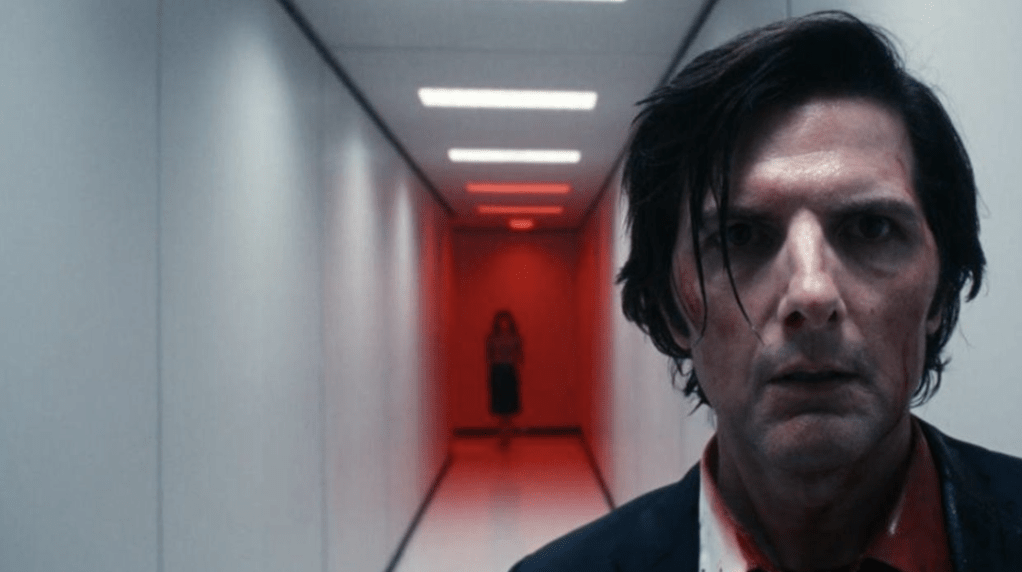
In this scene, we’re reminded of Mark S’s declaration in season 1 that innies are “people, not parts of people”. As Mark S, covered in blood, takes Helly’s hand instead of Gemma’s, he sees this belief through to fruition.
While we’ll have to wait for season 3 to see how this choice plays out, it’s a powerful moment born from two years of enslavement, subjugation, and quiet resistance. The pair may not know where they’re headed, but for the first time, their path is their own – chosen freely instead of assigned.
 The Curve Magazine