

Exploring Provocative Narratives of Desire, Sacrifice, and Marginalized Identities
By Shannon Pendleton
*Spoilers ahead for Society of the Snow (2024), Yellowjackets (2021), Bones and All (2022), and Hannibal (2013)*
In recent years, cannibalism has become an increasingly popular metaphor used by film and TV to represent love.
The latest piece of cannibalism-themed media is Society of the Snow, released onto Netflix in early January and nominated for Best International Feature Film at this year’s Oscars, which took place earlier this month.
The film follows the events of the 1972 Uruguayan plane crash where sixteen of the forty-five passengers involved survived in the Andes mountains of western Argentina for 72 days by consuming the flesh of those deceased.
While the Uruguayan survivors were first repulsed by the idea of cannibalising their dead, viewing the act as a violation of sacred life that would damn them to hell, it was eventually accepted. For example, survivor Javier Methol compares cannibalism to receiving Holy Communion, citing the New Testament: “He who eats of my flesh and drinks of my blood will have eternal life. Take and eat, this is my body.“
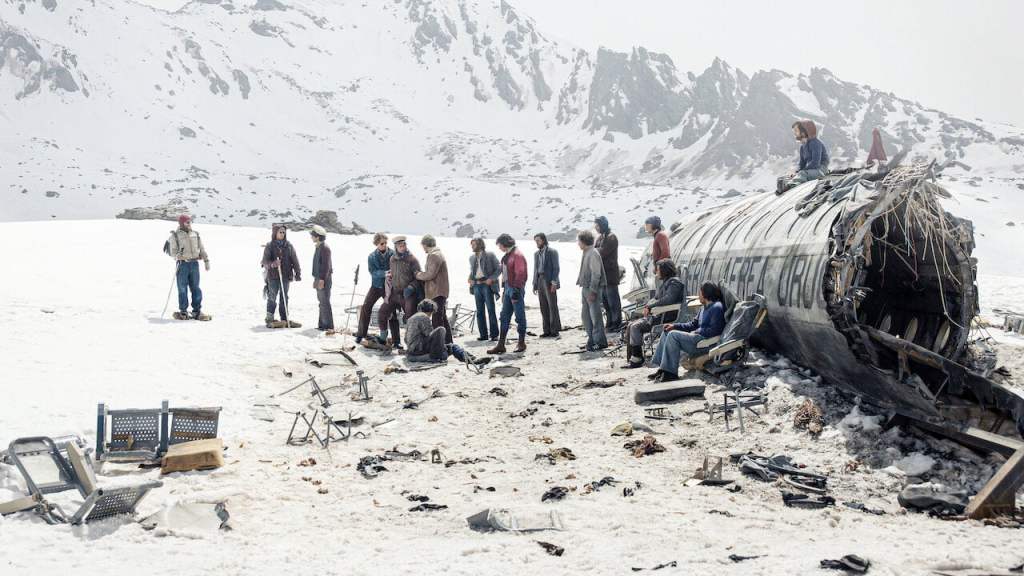
Similarly, the television series Yellowjackets (2021) follows a girls’ high school soccer team after being stranded in the Canadian Rockies with no choice but to resort to ‘survival cannibalism’ – the act of cannibalising someone out of necessity to survive rather than preference.
While Society of the Snow explores the true story of survival and sacrifice in raw and harrowing detail – from the painstakingly long plane crash sequence where bones are broken like twigs, and passengers fly from their seats to the sky like ragdolls – Yellowjackets takes a more symbolic and sensational approach.
Here, two central characters include Jackie – team captain – and her best friend, Shauna. Jealous of Jackie, it is unclear whether Shauna wants to be her or be with her, and since the show’s airing, many have speculated as to whether the girls’ feelings for each other are platonic or romantic.
In a turn for the worse, the two engage in a heated argument, resulting in Jackie sleeping outside and later freezing to death. After the group attempt to cremate her body, the girls awake in the night to the smell of roasted meat as the combination of snow and fire ultimately slow-cooked Jackie’s flesh.
Hesitant at first – looking around to see who will take the first bite and cross the invisible line – what soon unfolds is a ravenous display of consumption.
Jonathan Lisco, one of the show’s writers, posits that “The eating of a person is the ultimate way to dignify that person and keep her with you forever, while at the same time destroy her and dominate her”. This gives some insight into the love/hate dynamic between Jackie and Shauna and the ways in which cannibalism can become an act of love.
Similarly, Luca Guadagnino’s Bones and All (2022) – based on Camille DeAngelis’s 2015 novel – uses consumption to portray love between two young cannibals. Eighteen-year-old Maren believes she’s the only one of her kind, and is shocked and disturbingly comforted when she meets Lee, another teenage cannibal.
Over the course of the film, the two fall in love and confide in each other about what DeAngelis refers to as “the bad thing”.
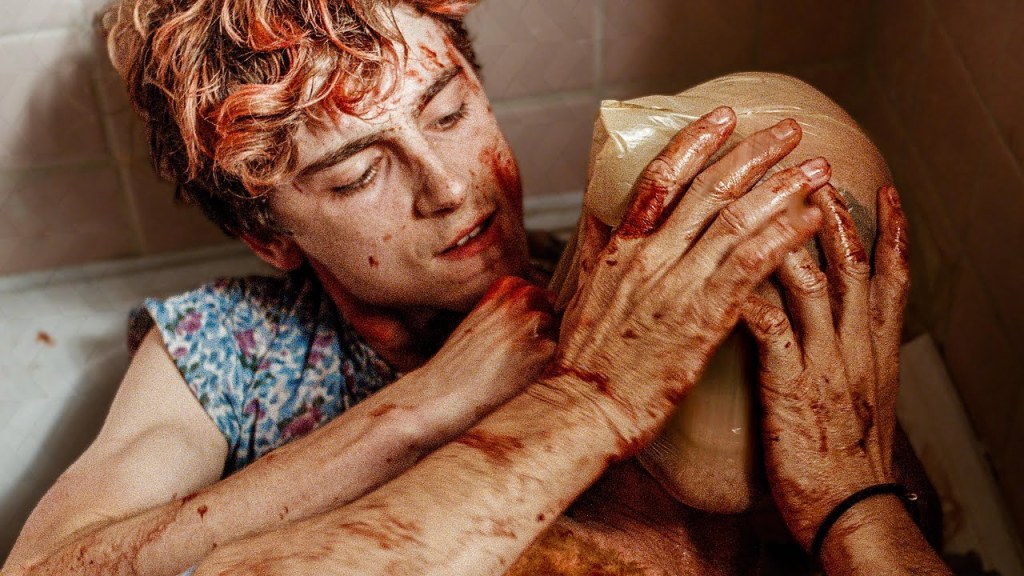
Believing themselves to be monsters, toward the end of the film the pair attempt “to be people” and live an ordinary life. However, their past soon catches up with them when Lee is fatally stabbed by another ‘eater’.
With raspy breath, Lee demands that Maren feed on his flesh as he dies, asking “Am I bad?” and insisting “It’s beautiful, it’s the easiest thing, Maren, love – just love me and eat”. Here, the parallels between cannibalism and love come into full fruition.
Maren typically eats to satiate her very specific kind of hunger, but when she cannibalises Lee, it becomes a form of love making. Indeed, Lee’s face is “twisted into an expression of pain and ecstasy” as she eats him alive.
Although the scene is horrific, it is also deeply romantic. By physically consuming Lee, Maren is embracing him wholly – telling him that he is good when he asks if he’s bad, and accepting all of him, bones and all. Here, bones may represent the hardened and grittier parts of ourselves that we find difficult to love and accept.
Having killed and eaten his abusive father as a young teen, Lee has been riddled with guilt for years, tormented by his violent past and adamant that he is a monster for his crimes. Indeed, the two of them regularly murder and consume their victims in terrible ways, using just their teeth to rip into flesh and separate joint from joint.
Despite the violence committed by Lee and Maren, in this final sequence, cannibalism becomes an extended metaphor for love and acceptance between two people who, for their sins, have been pushed to the margins of society their whole lives.
It is also for this reason that the film has been embraced by the LGBTQ+ community – as has many cannibalism-centred pieces of media, including Yellowjackets and Bryan Fuller’s Hannibal (2013).
Cannibalism and queer love
Bones and All screenwriter, David Kajganich, explains that “Cannibalism is such a taboo of the civilized world” that it becomes “a great language for expressing how it feels when your completely natural way of being intimate [as a member of the LGBTQ+ community] is judged as morally violent and socially destructive”.
Although the queer themes in Bones and All remain in the subtext, Hannibal brings these themes out into the open through the explicit romance between Hannibal and FBI profiler, Will Graham.
In the show’s penultimate episode, Will asks Bedelia, Hannibal’s psychiatrist, “Is Hannibal in love with me?” to which Bedelia replies, “Could he daily feel a stab of hunger for you and feel nourishment at the very sight of you? Yes”. Here, it becomes apparent that Hannibal’s capacity to love runs parallel to his need for violence.

Similar to Maren’s journey, Drumlin N. M. Crape suggests that while “Hannibal’s desire to consume” begins as primal and violent, through his love for Will it becomes a form of “sensual, erotic, and romantic yearning”.
Crape explains that Hannibal’s queer love for Will affords humanity to a villain whose queerness has previously been used to emphasise his monstrosity.
First appearing in Thomas Harris’s novel Red Dragon (1981), Hannibal is only implied to be queer, but this characterisation remains “part of a legacy of queercoding within the gothic mode” that is used to signify “the villain or monster”.
Crape argues that while Harris “invokes queerness as a function of horror, Fuller constructs a version of Hannibal who engages in a tender and fraught romantic relationship with another man” in a way that becomes “redemptive and humanizing” for the character, contradicting the homophobic “tradition from which it grows”.
Love, consumption, and sacrifice
Cannibalism has a rich history in film and TV and can be used to portray an intimate and uncomfortable look at love while illustrating the idea of ‘the other’ to tell stories about marginalised groups of people.
The contrast created between the violence of eating someone alive and the romance of accepting a loved one entirely provides an expansive look at what love can involve – the good and the bad.
Cannibalism and consumption can viscerally depict the agony of loving someone – the torment of being consumed by them while wanting so desperately to be consumed – and has done so through love stories such as Maren and Lee’s, Hannibal and Will’s, and Shauna and Jackie’s.
While Society of the Snow focuses more on platonic love, it provides a realistic portrayal of how our bodies can become sacrifices to those we love and is perhaps why film and literature is so fascinated by these themes.
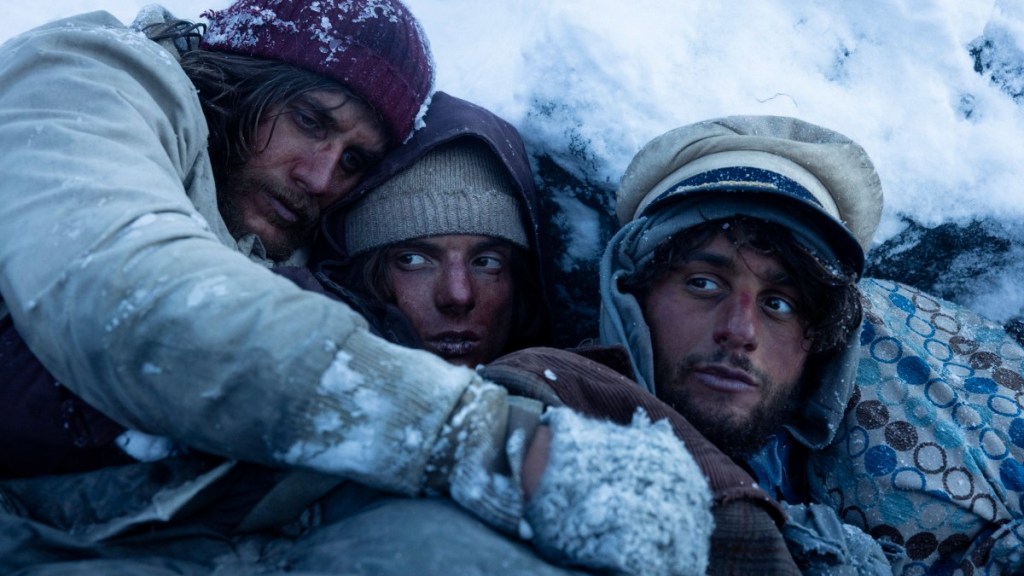
Importantly, Numa, the film’s narrator, didn’t survive the plane crash. The last to die, he passed away on the 11th December from a leg injury sustained during an avalanche. It may therefore be surprising that Society of the Snow selected Numa as their narrator – but it is essential that they did as he provides a voice to all those who died, forcing us to remember the tragedy in what has become known as ‘The Miracle of the Andes’.
In a note he left to the group following his death, Numa encourages his friends to ‘use his body’, reading “There is no greater love than to give one’s life for friends” – and so it becomes clear that stories like Society of the Snow, Bones and All, Yellowjackets, and Hannibal, are stories of love and sacrifice, rather than ones of horror and violation.
 The Curve Magazine