
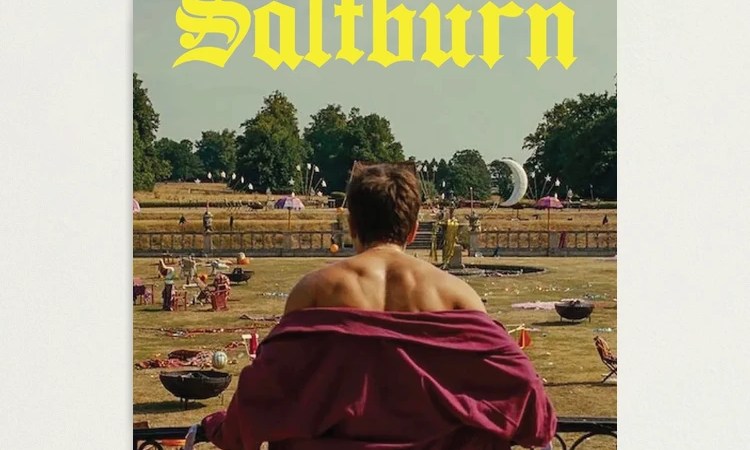
By Shannon Pendleton
Saltburn was released onto Amazon Prime last month and has since taken the internet by storm. Capturing the attention (and disgust) of audiences, it became the streaming platform’s No. 1 film throughout the Christmas period.
As Emerald Fennell’s second feature-film after her directorial debut in 2020 with Promising Young Woman, Saltburn is a scandalising exploration of class, power, sex, and what happens when love turns into obsession.
*Spoilers ahead for Saltburn*
Following the quietly off-putting Oliver Quick during his first year at Oxford University, Saltburn shocks and awes as we watch the misfit manipulate his way to the top after befriending the popular, gorgeous, and ultra-rich, Felix Catton.
Described by Fennell as a gothic dark comedy, Saltburn, in the first instance, is a satirical commentary on class privilege and power.
From the start, there is a clear power dynamic between Oliver and Felix. Coming from generational wealth, Felix is quickly captivated by Oliver’s family struggles and adopts a saviour role, making Oliver his working-class charity case.
Learning of Oliver’s father’s passing and his mother’s addiction struggles, Felix invites Oliver back to his sprawling estate, Saltburn, for the summer. From here, the dynamic between the two is amplified where the rest of the Catton family become morbidly fascinated by Oliver’s tragic family history.
After meeting the family, Oliver begins to sink his hooks into the group to gain importance and subvert the established power roles. This is primarily done through sex.
Sex becomes power
The significance of sex in Saltburn cannot be overstated, with Fennell herself stating to GQ that this is “a film about sex, and how that intersects with power”.
For example, after learning that Felix’s sister, Venetia, suffers from bulimia, Oliver exploits this knowledge to create an intimate sexual experience that positions him in a place of power and dominance and overrides their class difference.
Oliver has sex with Venetia while she is on her period and by doing so, he communicates to Venetia that “her body, rather than something disgusting, is in fact beautiful and arousing”, as Fennell explained in an interview with Time.
Indeed, periods are still stigmatised to this day and so are a point of insecurity and even embarrassment for many. And yet here – smudging Venetia’s blood on his face as well as hers – Oliver embraces and celebrates her as she is.
Fennell says, “It’s an incredibly effective sex scene because he’s worshiping her body, and everything that her body produces, and that’s not something that anyone has ever done for her before”.
Oliver makes it clear to Venetia that her body is something to be cared for and respected, and so when he commands that she eats more the next day, Venetia obeys, subverting the power dynamic between them.
Similarly, Oliver uses sex to assert power over cousin Farleigh.
After Farleigh snitches to Felix about Oliver hooking up with Venetia, Oliver sneaks into his room late at night. Sitting on top of Farleigh, physically overpowering him, Oliver asks, “Are you going to behave from now on?”. When Farleigh says no, Oliver proceeds to perform a sexual act on him, asking again if he’ll behave. Farleigh eventually submits and agrees to behave, illustrating Oliver’s control.
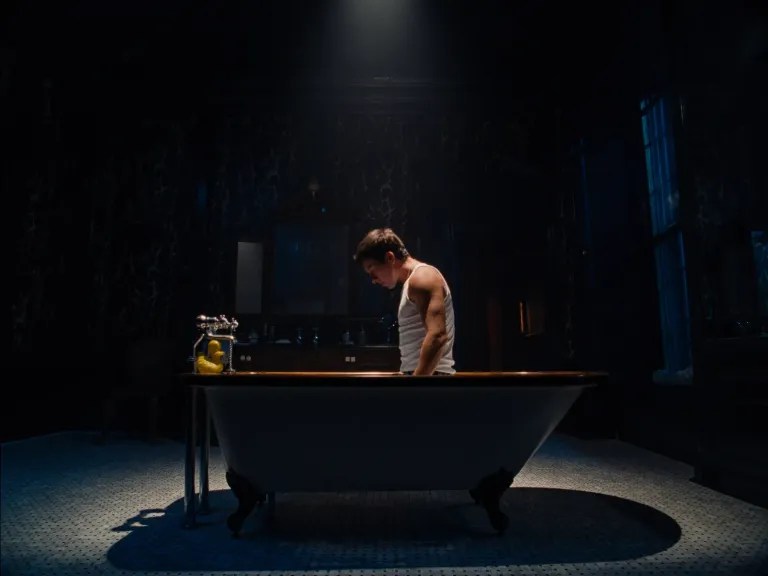
Finally, Oliver also uses sex to take control of others when they are not always aware. Voyeurism is a prominent theme throughout the film, as Oliver is constantly watching Felix having sex with women or even when masturbating alone in the bath, violating private moments.
This is taken to the next level when Oliver visits Felix’s grave. Sobbing and grief-stricken, Oliver undresses before having ‘sex’ with the earth that Felix is buried under. While Fennell describes this scene as “about love”, it feels more like a violation, born from a violent need to possess Felix in every possible way.
While Oliver never had sex with Felix in life, in his death he finds a way to find some version of sexual gratification and is a sign of unrequited love that has festered into dangerous obsession.

Indeed, Fennell explains in an interview with The Phoenix that Saltburn is “about what happens to you when you cannot touch the thing you want to touch, […] what happens when love can’t find its home”.
Love or obsession?
In an interview with Entertainment Weekly, Fennell provides some background on how Saltburn first came to be, explaining that her first thought of the story manifested as Oliver: “He was saying what the first line in the movie is which is, I wasn’t in love with him. And then there was the image of that same person licking the bottom of a bathtub. […] The first thing this person is saying is a lie.”
With this in mind, the film’s ending becomes very different.
Having murdered Felix along with his mother, Elspeth, and orchestrating the suicide of Venetia, Oliver inherits the Saltburn estate. In the final scene, Oliver dances – entirely naked – throughout the mansion to the 2001 song, Murder on the Dancefloor.
The scene is joyous and liberating, depicting how Oliver has risen through the ranks through any means necessary to come out on top. It can therefore be read as a happy ending for the anti-hero, but with Fennell’s insight in mind, this scene becomes nothing more than a hollow display of wealth and power.
Fennell explains that “So much of Oliver’s desire cannot be sated. What he really wants isn’t possible. […] We have him getting a version of what he wants, but he’s still alone. He’s still there with the rocks not the people”, referring to four rocks that are labelled with each dead Catton’s name.
Although the rocks were originally a way for the family to memorialise their late loved ones, once stolen by Oliver, they become haunting trophies that symbolise the human cost to his obsession.
Positioning the rocks on top of a puppet theatre, also labelled with the family’s names, Oliver’s triumph is clear – as is his solitude.

Is this the ending that Oliver truly wanted?
While there is an argument to be made that Oliver was motivated by wealth, endeavouring from the start to gain riches and status, as we ponder Fennell’s sentiment that Oliver’s first sentence was a lie, and that was the cornerstone of what Saltburn was built on, it becomes clear that Fennell intended the film to be a love story where what Oliver wanted was Felix.
Fennell even goes on to compare Saltburn’s grotesque grave scene to the tragic love story, Wuthering Heights, “where Heathcliff digs down to get to Cathy’s coffin and the subtext is very much to do a similar thing”. Fennell posits that Oliver’s violation of Felix’s grave displays “the horror of love”.
Here, I disagree with Fennell’s argument. I believe this scene – and the film as a whole – to illustrate the horror of obsession.
The idea that Oliver is more obsessed with Felix than in love with him is suggested by Oliver’s tendency to copy.
From the beginning, the differences between Oliver and Felix are glaring. Where Felix towers above crowds – laid-back cool guy with all the time in the world, able to get a girl back to his room with a single look – Oliver is short and unassuming, bespectacled and with clothes too big for him. But as the film progresses, Oliver works his hardest to emulate Felix, swapping collared button-downs for breezy polos, losing the glasses and even taking up smoking.

This transition becomes even more clear when a grief-stricken Venetia notices Oliver is wearing her brother’s aftershave and jabs, “You are a f*cking freak. I’ll bet you’re wearing his underwear too”.
Like a chameleon, Oliver watches and then mimics – although never truly becomes.
Even though Oliver ends up on top, he didn’t get the ending he truly wanted and I don’t think he was capable of it either.

While love can be undoubtedly painful, often ugly, full of desperation and selfishness, Oliver violates and disrespects Felix in a way that would never translate to a romantic relationship even if Felix reciprocated.
Fennell insists Oliver and Felix’s relationship is “a love story that never happened”, but in the end, I believe Saltburn to be an intensely and uncomfortably intimate look at desire and what happens when that desire rots into an obsession that consumes and destroys.
 The Curve Magazine
