
By Shannon Pendleton
Spoilers ahead for seasons 1 and 2 of Yellowjackets
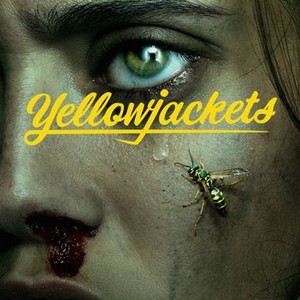
Yellowjackets follows a group of schoolgirls who, on their way to the 1996 soccer championships, become stranded after their plane crashes in the middle of the Canadian Rockies.
The group is left to survive in the wilderness for nineteen months before they are rescued, and so, as time goes on, and the girls become more and more desperate, starving, freezing, vulnerable to wild animals, and losing a grip on their sanity, they slowly push the boundaries of what they’re willing to do to survive.
This leaves the audience disturbed and enthralled as we eventually witness heinous acts of cannibalism and ritualistic sacrifice.
Switching between past and present day, we are shown the psychological fallout of the girls’ trauma; now middle-aged women, the Yellowjackets have struggled to assimilate to civil society, misunderstood by their peers who could never fathom what they survived – and the things they had to do to survive.
While Natalie crawls into a bottle to numb her pain, Misty fails to connect with anyone other than her parrot, Caligula; while Travis dies by suicide, Lottie heads a ‘wellness centre’ (borderline cult).
The only two women who have seemingly found some kind of normality after their trauma, having had children and tied the knot, are Taissa and Shauna; however, their marriages crumble as Taissa buries herself in her work and Shauna has an affair.
While it is clear the girls have struggled to adapt to ordinary life after their trauma, they seem to have found a way to come to terms with the measures they took to survive through leaning into the idea of a greater force at play.
Towards the end of season 2, the girls are starving to death when Misty comes up with an idea. They form a circle and each draw from a pack of cards – whoever draws the Queen is to be sacrificed and eaten.
When Natalie draws the ill-fated card, the hunt begins. However, during the chase and whilst trying to protect Natalie, the coach’s son, Javi, falls into a frozen lake.
Instead of running to his rescue, the team watches as the young boy thrashes and struggles, eventually drowning to death in the ice-cold water.
They then pull him from the lake, his body stiff and blue.

Like an animal they’ve hunted, the girls tie his hands and feet to a tree branch and carry him back to base.
When met with Ben, the assistant coach who is growing more and more disturbed by the girls’ behaviour, Natalie explains that it was ‘the wilderness’ that chose Javi.
When Travis, Javi’s older brother, is presented with his sibling’s bloody heart, the girls say to him, ‘let your brother save you’, using their faith in the wilderness’ choice to convince themselves that Javi wanted this too.
The reality is, of course, that Javi died, panicked and deserted, as he looked to those older than him for help.

By entrusting that it was the wilderness and not them who let the youngest of them die, the girls are using spirituality as a coping mechanism, designed to alleviate not only the guilt of what just happened, but also the trauma.
The idea that people in crisis are more open to religion and supernatural beliefs is one that’s been explored and debated across academic disciplines for decades. Philosopher, Ludwig Feuerbach, theorised in the 1950s that religion functions as a coping mechanism against anxiety, while cultural anthropologist, Scott Atran, discussed in his 2002 book, ‘In Gods We Trust’, that religion protects against psychological suffering.
Furthermore, researchers have found that religious faith becomes more appealing to participants once reminded of tragic suffering, danger, randomness, and death.
This is explained by an attempt to seek comfort in times of crisis.
For example, Christchurch New Zealand suffered an earthquake in 2011 that killed 185 people. In the aftermath, it was found that religious faith increased despite an overall decline in religious faith elsewhere.
In short, religion – or the idea of a greater force – comforts people. In fact, in 2012, psychologists, Inzlicht, Tullet and Good, found that activity in the anterior cingulate cortex – the part of the brain that produces distress signals – decreased when religious beliefs were expressed.
It therefore makes perfect sense that the Yellowjackets would turn to spirituality to comfort themselves.
‘Is there a difference?’
In the finale of season 2 – which premiered on the 28th May this year – the girls’ strained faith in the wilderness comes to a head.
In a confession to her therapist – who is later revealed to be a hallucination – Lottie expresses her belief that she was never actually mentally ill in the first place.
Her visions have returned after decades without them, and she believes they are the wilderness communicating with her once again.
After this revelation – or psychotic episode – Lottie proposes to Taissa, Shauna, Natalie, and Misty, that they sacrifice one of the group to appease the wilderness for a final time.
When Lottie insists that they ‘have to give it what it wants’, Shauna rebuts, ‘You know there’s no “it” right? “It” was just us’. Without skipping a beat, Lottie responds, sombre but relentless, ‘Is there a difference?’.
Upon first viewing, it’s natural to be taken aback by Lottie’s lack of concern for whether the power of the wilderness was real or not.
Lottie, the one whose visions, premonitions, and affinity for nature propelled the girls’ descent into terrible cult-like practices, no longer cared if their actions were in the name of something greater. But, in reality, her response reveals a more deeply held belief in the wilderness.
As Valerie Stoker explains in her insightful piece, ‘On Religion and Modern Life in Yellowjackets and Severance’, the girls’ experience of religion and spirituality becomes ‘psychosomatic’ in nature, ‘rooted in [their] body’s organs and chemistry’.
The idea that religion can be found in the body isn’t a new one, with many Christian verses sharing the sentiment that God lives in those who believe in him.
And so, when Shauna insists that ‘it’ was them all along, this doesn’t waver Lottie’s supernatural belief because she believes the girls and the wilderness are one and the same.
Taissa is the least spiritual out of the group, often getting into arguments with her girlfriend, Van, as they disagree on Lottie’s teachings.
And yet, while sleepwalking as an adult, Taissa creates a shrine to the wilderness in her basement and sacrifices her family dog – a bloody and grotesque scene hidden from her family and herself as her faith in the wilderness lives on in her body, separated from her conscious mind.
It is therefore clear that, whether the girls consciously believe in the wilderness or not, it continues to remain ‘rooted’ in their bodies.
The Wilderness or the Yellowjackets?
After a series of chaotic events reminiscent of the sacrificial hunts the girls took part in as teenagers, Misty accidentally gives Natalie a fatal dose of phenobarbital.
Affirmed in her beliefs, Lottie declares that the wilderness has chosen.
However, as Natalie’s body is wheeled into an ambulance, and Lottie is shipped off to a mental facility, the audience is left to ponder Shauna’s statement of whether ‘it’ was them all along.
As the credits roll, we question if the murder that tends to follow the Yellowjackets is created by a supernatural force, or if it’s simply just them, still fighting to survive and find comfort in a wilderness of their own making.
 The Curve Magazine